




By Dr. Fadi Zaher, CIO
Last month, I made a promise with a deadline attached. If the advantage held by resource-efficient companies collapsed once the oil tailwind was gone, I would say so here. As I write, earnings season is only just opening – I have no results, no verdict, and nothing to report.
So, before earnings settle the question, let me be clear about what we expect to see – and what would convince me we are wrong.
The test began before we could possibly know the answer
The asset-heavy industrials and materials companies, which are some of the most environmentally intensive, report through late July and August. Our expectation is that efficient companies’ margin resilience should continue to track resource efficiency even with oil back below eighty dollars. The efficient operators should keep defending margins their less efficient peers cannot. If instead that edge evaporates the moment the energy tailwind disappears, then what we saw in April was an oil trade wearing our clothes, and I will write exactly that next month.
Another cost the market is overlooking
While markets have focused on energy prices, there is a cost building inside company accounts that almost no model catches because it does not arrive as a single identifiable expense. There is no line marked “it was too hot to work.”. Heat turns up in disguise instead. Output per shift quietly falls, cooling bills climb, machinery wears faster and maintenance frequency increases. Crops disappoint, supply chains stumble, and it becomes clear which companies have had the foresight to adapt to a hotter world, and which have been burying their head in the sand.
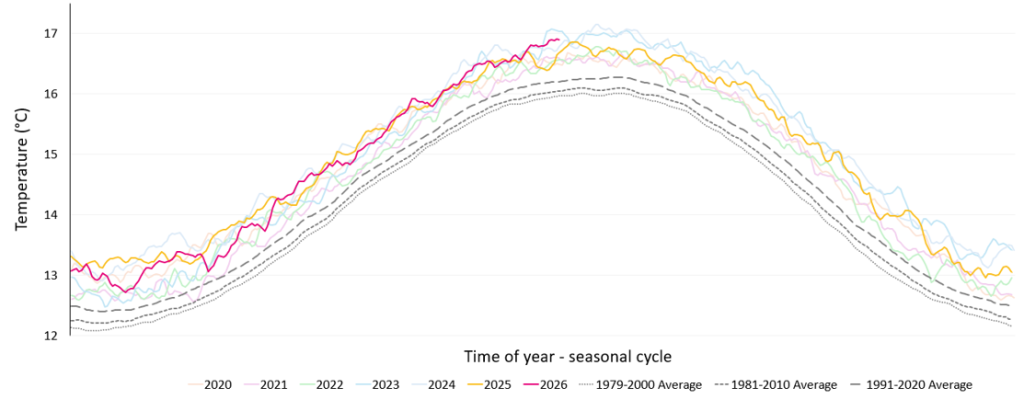
Over the past year, our team have been measuring heat exposure company by company, mapping which businesses sit in high-heat-stress locations and which depend on human labour or ambient cooling to function. The most exposed are rarely those with the worst headlines, but the businesses whose operations rely on climate conditions that are becoming progressively less reliable.
Why I think the market has the timing wrong
Most climate risk models still treat heat as a tail risk to stress test in 2040. That has the timeframe backwards. Heat is a cost sitting in this year’s margins, in industries that are reporting now. A portfolio carefully modelled for a warmer 2040 while ignoring what warmth is doing to earnings in 2026 is not manging risk, it’s postponing it.
A developing El Niño is now loading extra warmth onto a baseline that has already produced the three hottest years on record. A cost we can already measure is about to be tested. If the companies we identify as more heat-resilient continue to defend margins more effectively, we will explain why. If they do not, we will explain that too.
Where our research goes next
Thinking this way has changed how we build research. Over the last few months we have been developing a Transition Capital scenario generator, which stress tests a company’s financial and climate balance sheets together across a range of scenarios. It answers a question most investors cannot yet answer with rigour: which businesses have the financial capacity to survive the climate transition, and which do not? There will be much more on this soon. In the meantime….
An offer, rather than a promise
If you’re curious how these risks look inside your own portfolio, we’d be happy to run it through our framework and talk through the results. No charge, no obligation, and no obligation to like the answer either.
Our commitment has not changed. It is to understand the mechanism, act on it with discipline, and to tell you plainly how it turns out.
Important Information
This document is issued by Osmosis Investment Management UK Limited (“Osmosis UK”). Osmosis UK is an affiliate of Osmosis Investment Management US LLC (“Osmosis US”), Osmosis Investment Management NL B.V. (“Osmosis NL”) and Osmosis Investment Management AUS Pty Ltd (“Osmosis AUS”), and has been operating the Osmosis Model of Resource Efficiency. Osmosis UK is regulated by the FCA (Reference number: 765056). Osmosis US is regulated by the SEC. Osmosis NL is licensed as a manager of AIFs and authorised to provide discretionary portfolio management services and as such is subject to supervision by the Netherlands Authority for the Financial Markets under registration number 15006165.Osmosis UK, Osmosis US, and Osmosis AUS are wholly owned subsidiaries of Osmosis (Holdings) Limited (“OHL”).
This research provided is for information purposes and does not constitute an offer or solicitation of an offer or any advice or recommendation to purchase any securities. No representations, express or implied, are made as to the accuracy or completeness of such statements, assumptions, estimates or projections or with respect to any other materials herein.