



By Dr. Fadi Zaher, CIO
Two months ago the market told a simple story. Oil rose sharply, the cost of running an inefficient business climbed with it, and resource-efficient companies pulled ahead1. It was a tidy story, and tidy stories are the ones worth distrusting, because they rarely survive a reversal.
Oil has since given back most of that move. The easy story faded. The signal did not. That is the whole point of this letter, so I will not bury it. When the oil tailwind disappeared, our edge stayed. A signal that only works when the headlines cooperate is not a signal, it is a coincidence in a good suit. MoRE, our Model of Resource Efficiency, measures how much economic output a company wrings from the resources it consumes. It does not care where oil traded this week. But if the signal does not run on the oil price, the fair question is what it runs on. The answer is resource pressure itself, and that pressure is building fastest where few investors are looking.
Start with power. The electricity that data centres draw could more than double by 2030, to roughly the entire power consumption of Japan today, as the world races to feed artificial intelligence. When the defining growth story of the decade is, underneath, an energy story, the companies that do more with each unit of power are not running a worthy side-project. They are running a cost advantage.
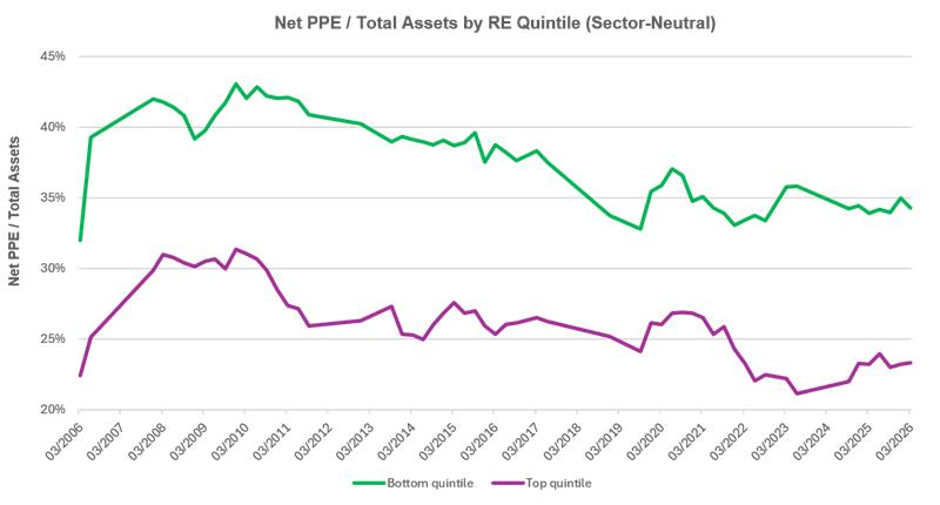
That logic reaches far beyond data centres. Our research finds the signal bites hardest in companies heavy with physical assets. A software firm barely feels the price of energy or carbon. A steelmaker, a cement producer, a logistics operator feels every penny. The more physical infrastructure a company must operate, maintain and power, the more valuable each unit of avoided resource use becomes. For these businesses, resource consumption is not a side issue. It is embedded in the economics of production itself.
That is exactly where efficiency separates winners from losers, because that is where costs are large enough to move earnings. The performance gap between efficient and inefficient operators is modest among asset-light companies and dramatically wider among asset-heavy ones. If you want efficiency to earn its keep, you look where the physical assets are heaviest.
Where resource efficiency pays most. The efficiency advantage is widest among companies with heavy physical assets.
Energy is only the first of these forces. Carbon is the second. Carbon makes the same case in a different language. This year the EU’s carbon border levy began billing importers for the emissions baked into steel, cement and fertiliser. The headline price is the dull part. How unevenly it lands is the revealing part. Take cement. Two competitors in the same business now face entirely different bills, one shielded by stockpiled allowances until past 2030, the other facing close to €50 a tonne by then. Same industry, same rules, opposite economics. The industry label tells you little. The company’s own resource position tells you almost everything.
A third pressure is showing up in materials. Commodity prices are sending the same message in a different form: waste is becoming more expensive. Across a range of inputs, from copper, aluminium, lithium, rubber and cotton to agricultural commodities such as cattle and wool, prices have risen materially over the past year. There are always counterexamples, and each commodity has its own story, but the direction of travel matters. When physical inputs become more costly, the ability to convert materials into output with less waste becomes a financial advantage.
Three forces, energy, carbon, and materials are pointing at the same companies. So here is what we commit to, and what we are watching. If we are right, the efficiency advantage should hold or widen as company results land in late July, even with oil lower. If it collapses once the tailwind is fully gone, our diagnosis is incomplete, and we will say exactly that, here, next month. The part we are least sure of is carbon: whether the market is already pricing the gap between cement’s winners and losers, or simply ignoring it. We lean towards ignoring it, which is why we are watching those names closely.
Our promise was never to be right about every headline. It is to be right about the mechanism, and to tell you plainly when we are not. The headlines, as oil reminded us this quarter, have a habit of un-happening.
Important Information
This document is issued by Osmosis Investment Management UK Limited (“Osmosis UK”). Osmosis UK is an affiliate of Osmosis Investment Management US LLC (“Osmosis US”), Osmosis Investment Management NL B.V. (“Osmosis NL”) and Osmosis Investment Management AUS Pty Ltd (“Osmosis AUS”), and has been operating the Osmosis Model of Resource Efficiency. Osmosis UK is regulated by the FCA (Reference number: 765056). Osmosis US is regulated by the SEC. Osmosis NL is licensed as a manager of AIFs and authorised to provide discretionary portfolio management services and as such is subject to supervision by the Netherlands Authority for the Financial Markets under registration number 15006165.Osmosis UK, Osmosis US, and Osmosis AUS are wholly owned subsidiaries of Osmosis (Holdings) Limited (“OHL”).
This research provided is for information purposes and does not constitute an offer or solicitation of an offer or any advice or recommendation to purchase any securities. No representations, express or implied, are made as to the accuracy or completeness of such statements, assumptions, estimates or projections or with respect to any other materials herein.
Our research identifies companies from the MSCI World or Emerging Market Index that report sufficiently on at least 2 of the following 3 metrics: carbon, water, and waste, to calculate a resource efficiency score for each reporting company – the Model of Resource Efficiency. Our Core strategies overweight efficient companies and underweight inefficient companies within each Osmosis defined sector, to remain sector neutral to each benchmark. Our Active strategies invest only in efficient companies, outside of the Financial sector described below. Companies in the Financials sector are not given Resource Efficiency Scores. Certain strategies select Financials, based on complementary characteristics to the Resource Efficiency factor, for inclusion in the portfolio to maintain the portfolio’s overall factor weightings. All strategies exclude tobacco and companies that breach the UN Global Compact on social and governance safeguarding.
The information contained in this document has been obtained by Osmosis from sources it believes to be reliable, but which have not been independently verified. Information contained in this document may comprise an internal analysis performed by Osmosis and be based on the subjective views of, and various assumptions made by, Osmosis at the date of this document. Osmosis does not warrant the relevance or correctness of the views expressed by it or its assumptions. Except in the case of fraudulent misrepresentation or as otherwise provided by applicable law, neither Osmosis nor any of its officers, employments or agents shall be liable to any person for any direct, indirect, or consequential loss arising from the use of this document.
- Based on companies within MSCI World split into two groups: the most resource-efficient companies and the least resource-efficient companies based on Osmosis Model of Resource Efficiency. Our research identifies companies from the MSCI World or Emerging Market Index that report sufficiently on at least 2 of the following 3 metrics: carbon, water, and waste, to calculate a resource efficiency score for each reporting company – the Model of Resource Efficiency. ↩︎