



By Dr. Fadi Zaher
Earnings season is a time when a strategy has nowhere to hide behind macro headlines. Last month, I set a test for our resource-efficiency thesis: If efficient companies could hold their margins even as oil slipped back below eighty dollars, the signal is more than an energy trade. If that strength evaporated, then our spring was mostly crude oil in a good disguise.
The first results are in: they lean our way.
Spring was uncomfortable, and I will not pretend otherwise. A narrow band of AI-linked mega-cap technology names led the market, industrials ran hard alongside them, and both worked against how we are positioned. For a few weeks, our focus on efficiency looked out of sync, despite underlying businesses remaining unchanged. July felt different. The most crowded corners of the market cooled, our holdings held their ground, and company results nudged attention back to the things that matter to our investment process: margins, capital discipline, and resilience.
Our Core Equity Strategy recovered ground in July, and has edged slightly positive over three months to its benchmark, on a net basis. Similarly, Emerging Markets Core Equity is also up more than one per cent, on a net basis, over the same period. And, our best ideas International Strategy gained over two per cent, on a net basis, in July alone. One month is not a trend, and I will be the first to say so. But, as leadership broadened, the fundamentals we favour started to count again. That is the part I will not let slide.
The real story of the month is the crowd
That shift is a symptom of something bigger – something active investors are hoping toc ignore and passive managers blindly follow. Global indices have rarely been as concentrated as we see them today. For example, the ten largest companies in the MSCI World now make up roughly a third of the index, up from about seventeen per cent five years ago. Concentration is even greater in emerging markets, where the ten largest stocks account for nearly 40% of the MSCI EM Index. Spread yourself across every country and sector you like; you can still be quietly betting the house on a handful of US mega-caps.
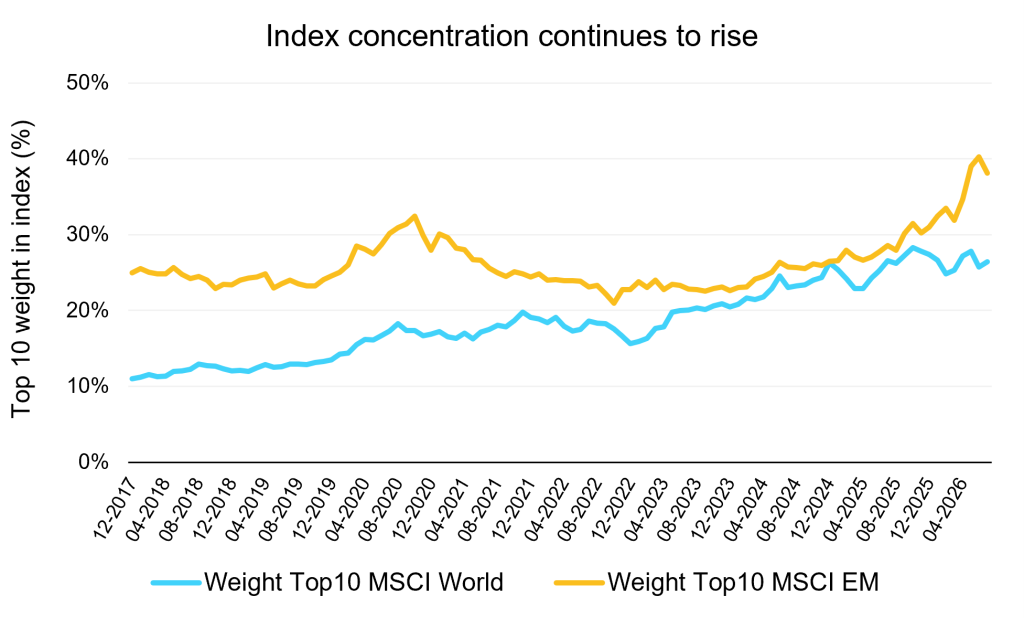
This quietly rewrites the job of market indices. A cap-weighted index forces you to own more of whatever has already risen the most, in the largest size, at the least attractive price. So “neutral” on the giants is not neutral. It is a large, one-way bet. Match the index, and you are fuelling the crowd’s conviction and calling it a strategy. Underweight them, though, and you can be left behind in the years they keep rising. There is no safe choice here, and we have sat on both sides of it. For years, owning Apple and then Nvidia in our Core Equity Strategy helped our returns. Since the start of 2025 that has changed, and the biggest companies have held us back, with Alphabet hurting us the most. That is how concentration works. It helps you, and then it turns on you, on a scale large enough to bury the patient work a strategy is built on.
And, it is not only a developed-market problem. Emerging market indices are, if anything, more lopsided still: a few countries dominate the map, and a handful of names, Taiwan Semiconductor chief among them, now carry outsized single-stock weights, swollen by the very same artificial intelligence demand inflating the mega-caps in the developed world. The same wave is concentrating both indices at once – a global phenomenon wearing two passports.
A benchmark this concentrated isn’t truly diversified. It’s increasingly reliant on momentum – we cannot predict Nvidia’s performance, but we can decide how much exposure we are willing to have to it.
Staying ahead of the crowd
Our answer is not to guess which mega-cap wins next. It is to manage the risk deliberately while leaving the core of the strategy fully intact. Two efforts are underway in coming weeks and months:
- Tighter single-stock risk limits: In testing, capping any one name near a top-ten index weight reduces concentration risk while leaving long-run return and volatility essentially unchanged. Letting go of our largest single-stock bets costs almost nothing in expected return, which is about as close to a free lunch as this business offers.
- Finalising our new Multi-Factor range: A new range of strategies pairing value, quality, momentum, low risk and size, combined with our resource-efficiency screen and a factor-crowding signal. Helping to navigate market concentration in current dynamic conditions, you’ll hear a good deal more about it from me shortly.
A note of caution, with the promise unchanged
We should not read too much into a few weeks. Market leadership can change quickly, and it is too early to draw firm conclusions. Still, the test played out as expected: once the effect of oil prices faded, the more efficient companies retained their advantage.
One month does not prove the case, but it is an encouraging sign that we are measuring what matters. Our job is to keep testing that, and to be clear with you about whether it is working. This month, it did.
Important Information
This document is issued by Osmosis Investment Management UK Limited (“Osmosis UK”). Osmosis UK is an affiliate of Osmosis Investment Management US LLC (“Osmosis US”), Osmosis Investment Management NL B.V. (“Osmosis NL”) and Osmosis Investment Management AUS Pty Ltd (“Osmosis AUS”), and has been operating the Osmosis Model of Resource Efficiency. Osmosis UK is regulated by the FCA (Reference number: 765056). Osmosis US is regulated by the SEC. Osmosis NL is licensed as a manager of AIFs and authorised to provide discretionary portfolio management services and as such is subject to supervision by the Netherlands Authority for the Financial Markets under registration number 15006165.Osmosis UK, Osmosis US, and Osmosis AUS are wholly owned subsidiaries of Osmosis (Holdings) Limited (“OHL”).
This research provided is for information purposes and does not constitute an offer or solicitation of an offer or any advice or recommendation to purchase any securities. No representations, express or implied, are made as to the accuracy or completeness of such statements, assumptions, estimates or projections or with respect to any other materials herein.
The investment examples set forth in this presentation should not be considered a recommendation to buy or sell any specific securities. There can be no assurance that such investments will remain in the strategy. The case studies have been selected to be included in this presentation because we believe these are indicative of our strategy and investment process. Nothing herein shall be deemed to limit the investment strategies or investment opportunities to be pursued by Osmosis.
Our research identifies companies from the MSCI World or Emerging Market Index that report sufficiently on at least 2 of the following 3 metrics: carbon, water, and waste, to calculate a resource efficiency score for each reporting company – the Model of Resource Efficiency. Our Core strategies overweight efficient companies and underweight inefficient companies within each Osmosis defined sector, to remain sector neutral to each benchmark. Our Active strategies invest only in efficient companies, outside of the Financial sector described below. Companies in the Financials sector are not given Resource Efficiency Scores. Certain strategies select Financials, based on complementary characteristics to the Resource Efficiency factor, for inclusion in the portfolio to maintain the portfolio’s overall factor weightings. All strategies exclude tobacco and companies that breach the UN Global Compact on social and governance safeguarding.
The information contained in this document has been obtained by Osmosis from sources it believes to be reliable, but which have not been independently verified. Information contained in this document may comprise an internal analysis performed by Osmosis and be based on the subjective views of, and various assumptions made by, Osmosis at the date of this document. Osmosis does not warrant the relevance or correctness of the views expressed by it or its assumptions. Except in the case of fraudulent misrepresentation or as otherwise provided by applicable law, neither Osmosis nor any of its officers, employments or agents shall be liable to any person for any direct, indirect, or consequential loss arising from the use of this document.