



By Bob Stoutjesdijk, Global Macro Strategist
Quick Read:
- The big question has changed. It used to be when the Fed would cut rates. Now it is whether the Fed will have to raise them, with the ECB having already started and rising energy prices pushing the Fed the same way.
- Credit cycles rarely end on their own. They end when central banks raise rates so far that something breaks, and history shows the Fed almost always goes too far.
- Yet the usual warning signal says little right now. Before the 2008 crash, the risk premium on credit stayed calm right up to the final rate hike and only jumped afterwards. By the time the signal arrives, it is usually already too late.
- And that low premium can stay low for a very long time. In 1989, 2006 and 2018 it stayed low for years before anything happened. So low does not mean trouble is coming soon.
- But the premium today is unusually low, about as low as it has been since the 1950s. That leaves very little protection if the Fed does end up pushing the economy into trouble.
- We are not predicting a downturn. The economy is solid, companies are carrying less debt, and a soft landing is still possible. So we stay focused on quality and on picking the right individual bonds. This is a market that rewards careful selection, where you can still be paid properly for the risk you take.
Macro: From Cornered to Forced
In May we argued that the Fed and ECB were cornered on both sides of their mandate, with no policy rate that resolved inflation and growth at once. A month on, the corner has narrowed into a push towards the exit few expected: rate hikes. The ECB has already walked through it; the Fed is being pressed toward the same door.
Start with the US data since our last note. May payrolls came in at +172k, more than double consensus, with the two prior months revised up; the three-month average now runs near 188k against a far softer 92k six-month trend. Unemployment held at 4.3% for a third straight month, and the latest Job Openings report showed vacancies jumping to their highest in roughly two years. This is not the labour market of an economy that needs support. The cycle is running hotter than the consensus feared and broadly in line with what we have argued, carried by high-income consumption and an AI-capex wave.
Inflation is the more uncomfortable half. Headline CPI hit 4.2% year-on-year in May, a three-year high, with energy accounting for over 60% of the monthly gain after the Iran shock. Core held at 2.9%, so the pass-through is contained. But the GDP deflator tells a less reassuring story: economy-wide prices have run near 3.7-3.8% annualised since mid-2025 and never truly normalised after 2022. The June Beige Book captured the mix bluntly: activity still expanding across most districts, employment steady, but prices rising at a “moderate to strong” pace, with low-income households visibly squeezed.
This is the Fed’s dilemma in sharp relief: firm growth, a resilient labour market, and inflation re-accelerating on energy and second-round effects. Governor Warsh will likely hold at his first meeting, but should this persist, the Fed will have to hike to lean against price pressure, exactly the risk the divided April FOMC meeting pointed to.
The ECB faces the same shock through a different lens. Euro-area HICP rose to 3.2% in May, but here the inflation is far more squarely an energy story: the GDP deflator has held near 2.4%, close to its target-consistent pace, so domestic cost pressure is not building the way it is in the US. The divergence we flag for America simply isn’t there for Europe. What is larger is the cyclical growth hit, landing on an economy already deindustrialising and short of domestic momentum. The ECB nonetheless chose to act first, raising the deposit rate to 2.25% on 11 June, its first hike since 2023, and unanimously. The motivation is as much institutional as economic: having been badly wrong in calling the post-COVID surge “transitory,” the Governing Council is determined not to repeat that error and is now willing to risk over-tightening rather than lose the inflation anchor a second time.
We think this underestimates the growth side of the ledger. Higher energy costs and renewed supply-chain strain are themselves contractionary and raising rates into an externally driven shock compounds rather than cushions the damage to an economy that can least absorb it.
Spreads Warn Late
We are not forecasting the end of the cycle, but we are taking note of the possibility of multiple rate hikes to come and hence think it interesting to look at how a hiking cycle impacts the credit cycle as an investment theme. Credit cycles rarely die of old age. They end when the central bank tightens far enough that something breaks: equities fall, credit spreads widen, growth turns negative and unemployment rises. Higher rates expose the weakest link, and the cycle turns. That more hikes are coming now looks probable; that they break the cycle does not. The two are easily conflated, and the distinction is what matters for positioning.
The record is consistent. Of the roughly twelve Fed tightening cycles since the 1950s, most ended in recession within two years, and in the majority the Fed kept hiking after equities had already peaked. The popular “second-to-last hike” rule does not hold: in 2000 the peak came right around the final hikes, but in 1989, 2006 and 2018 only a year or more later. The lag from last hike to recession is also widely dispersed, from two quarters to as long as eighteen months, not reliably short.
The Moody’s Baa-Aaa credit spread, which runs back to 1919, makes this concrete. When the Fed breaks the cycle, the spread widens sharply; when it does not, it barely moves. In the 1994-95 soft landing it rose just 8bps and no recession followed; in 1973-74 and into 2008 it blew out to around 130bps and roughly 250bps. The key lesson is timing. Before 2008 the spread sat near 90bps at the final hike and was still there a year on; it only exploded after the Lehman event. Spreads therefore warn late, not early, and confirm the turn too slowly to wait for. See Graph 1 below.
The behavior of US Treasuries is equally interesting. Since the 1982 disinflation trend, the 10-year yield has fallen in every downturn as investors fled to quality, with 2000 and 2008 the clearest cases. But in the high-inflation cycles of the 1960s, 70s and 80s, bond markets kept underestimating inflation and long yields rose or stayed high even as growth weakened. With inflation now re-accelerating on energy, that earlier regime looks the more relevant guide. Treasuries would still rally hard, but probably only in a classic recession, not in an inflationary slowdown.
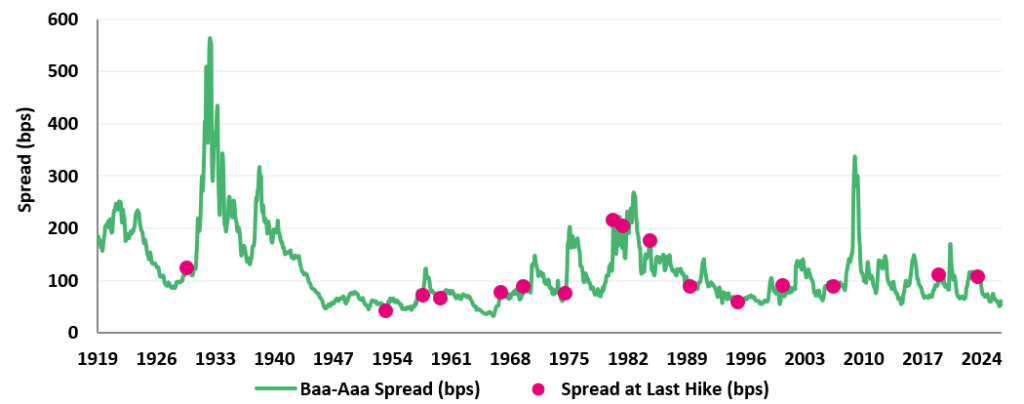
In June the Baa-Aaa spread stood at 54bps, the 7th percentile since 1954 against a median of 87bps, and not far off the all-time low of 32bps in January 1966, just before the soft landing today’s optimists like to cite. The lesson is twofold: spreads can stay tight far longer than expected (1989, 2006, 2018), but if the Fed breaks the cycle, it typically overdoes it, with spreads widening around the last hike with a two-quarter bandwidth. A risk that should not be underestimated at today’s valuations. The market is pricing a soft landing, which we think is possible, but only if the Fed does not break the cycle. We are not forecasting a break: the economy is firm, corporate leverage is falling, and a 1966-style landing remains possible. Hence our bias stays: up in quality, while seeking bottom-up positions that still offer sufficient safety margin. And yes, they do exist!
Download PDF:
Important Information
Osmosis Investment Management NL B.V. (Osmosis NL) is licensed as an Alternative Investment Fund Manager (AIFM) under the Alternative Investment Fund Managers Directive (AIFMD) and the Dutch Financial Supervision Act (Wet op het financieel toezicht, Wft) and authorized to provide discretionary portfolio management services. Osmosis NL is subject to supervision by the Dutch Authority for the Financial Markets (AFM).
This document and any marketing communication are intended solely for Professional Investors as defined in the Wft. It is not directed at, nor intended for distribution to, any person in any jurisdiction where such distribution would be unlawful.
The information provided is for general information purposes only and does not constitute investment advice, a recommendation, research or an offer or solicitation to buy or sell any financial instrument. It is not tailored to individual circumstances or investment objectives.
The views expressed are as of the date of publication of this document and may change without notice. Although this information is obtained from sources believed to be reliable, no representation or warranty is made as to its accuracy or completeness. Osmosis NL accepts no liability for any direct or indirect loss arising from use of this information.
Past performance is not a reliable indicator of future results. No representation or warranty is made that any account or investment will achieve results similar to those shown. Actual results may differ substantially due to factors such as market conditions, timing and pricing of trades, portfolio composition, fees, and client circumstances. Investments can fall as well as rise in value and may result in the loss of capital. Forecasts, projections, or targets are for illustrative purposes only and are not guaranteed in any way.
Any investment examples included herein are for illustrative purposes only and do not constitute a recommendation to buy or sell any specific security. There is no assurance that such investments will remain in the strategy or have ever been held. Case studies have been selected on a non-performance basis as indicative of the investment approach and process.
Benchmark information is provided for comparison purposes only. Indices are unmanaged, not available for direct investment, and do not reflect the deduction of fees or expenses, which would reduce returns. Past benchmark performance is not a reliable indicator of future results, and the referenced benchmarks may not be appropriate for all investors.
If reference is made to an investment fund, please refer to the relevant fund’s prospectus or offering documents with more details on investment objectives, costs, and risks before making any final investment decisions.
Scenarios and performance presented are estimates based on past data and current market conditions and are not exact indicators of future results. Actual outcomes will vary depending on market performance and the duration of investment.
Clients are encouraged to consult their own legal, tax, accounting, and other professional advisers before making investment decisions and to promptly inform Osmosis NL of any changes to their investment objectives or financial situation.
For Australian Investors: Osmosis NL is a Corporate Authorised Representative (CAR 001316961) of Eminence Global Asset Management Pty Ltd (EGAM) (AFSL holder 305573). Where Osmosis NL provides financial services in Australia, it does so as an authorised representative on behalf of EGAM. The information and materials contained in this document have been prepared for accredited wholesale clients only, as defined by the Corporations Act 2001 (Cth) and in accepting the content of this document, you warrant that you are such an investor.