




As founder control grows, investors may be taking on governance risk they neither chose nor fully priced
By Liam O’Connell and Lily Andrews
“With the global financial crisis, there was a mispricing of credit risk. Today, we’re seeing a mispricing of governance risks. Tracking error from the benchmark is essentially the price investors are paying for governance risk.”
Mispriced risk is visible today in the rise of founder-controlled companies. Some of the companies investors are most heavily exposed to are also those over which they have the least influence. Applying MSCI’s ownership classification, 40% of MSCI ACWI constituents have a single shareholder controlling at least 10% of the vote, including 28% where that shareholder controls more than 30%.
Where concentration risk is combined with unequal voting rights or other control-enhancing mechanisms, minority shareholders can have limited ability to hold management and controlling shareholders to account.
Public companies. Private control.
The democratisation of stock ownership over the past half century has been one of public markets’ greatest strengths. At its heart is the principle of proportionate shareholder influence. Governance shifts are however eroding this principle.
Companies are remaining private for longer, allowing founders to consolidate positions before entering public markets. At the same time, dual-class share structures have become increasingly common, enabling founders to retain disproportionate voting control after listing.
Such structures remain contested, with critics arguing they weaken corporate governance and limit management accountability. Because these are often the very companies driving index returns, market-cap weighting can increase investors’ economic exposure while their governance influence becomes increasingly constrained.
When governance becomes portfolio risk
For portfolio managers, this is where governance stops being a stewardship issue and becomes a risk-budget issue.
Index construction ensures these companies remain in the portfolio regardless of their governance structure, meaning exposure only continues to grow. Investors must therefore recognise that any portfolio decisions made on governance grounds could carry an unexpected tracking error cost.
Of course, concentrated control can be precisely what investors are buying into: the belief that an effective founder can pursue a long-term strategy without the constraints of dispersed shareholder control, but this rationale can weaken over time. As Bebchuk and Kastiel’s lifecycle theory sets out, this rationale falters with the age of the structure, while shareholder mechanisms to address emerging risks may have already been weakened.
This makes the value of the remaining shareholder vote particularly important. Where a company has two listed share classes, the price differential provides an indication of how the market values additional voting rights. In some controlled companies, this premium has fallen dramatically.
Alphabet is the clearest case. Its dual class structure was designed to protect the firm’s “ability to innovate and retain its most distinctive characteristics”, allowing founders to preserve significant influence after going public. Two decades on from its IPO, voting shares have traded at a discount to non-voting shares since 2020 (negative on 87% of days over the period). Similarly, using Bloomberg pricing data, Fox’s voting shares have traded at a discount on 95% of the days, with it now sitting at 11% below the non-voting equivalent, while Under Armour’s voting premium, although still slightly positive, has also eroded.
Where majority control is concentrated, an additional shareholder vote has little ability to alter an outcome. The price differential is then decided by other factors such as the greater float size and liquidity of the non-voting class. So, the market is pricing the vote accurately, given today’s concentrated control. What it isn’t pricing is the need for voting rights when principal-agent problems eventually occur.
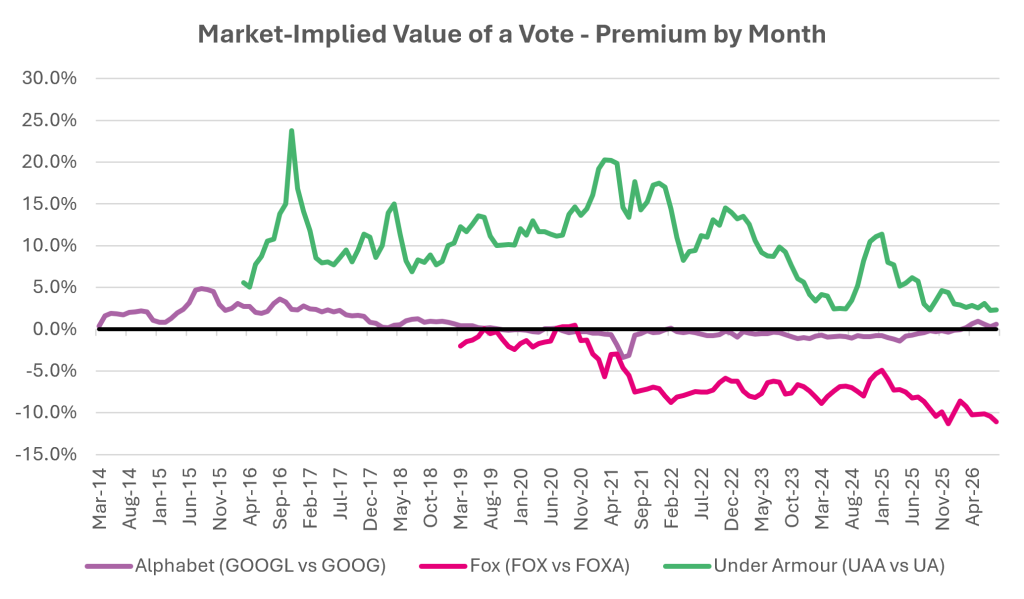
Source: Bloomberg. Lines begin at different points due to the differing start dates of the dual-class structure. Alphabet, Fox and Under Armour were selected as the companies in our sample where both higher-vote and lower-vote share classes are publicly listed, carry equivalent economic rights and trade regularly, allowing the value of a vote to be isolated.
Governance risk shows up in the numbers
This is not just a pricing phenomenon; it shows up in the underlying exposures too. Across MSCI All Country World Index (ACWI), controlled companies show no significant differences on accounting-based measures such as profitability, leverage, or earnings quality, once country and size are accounted for. However, as of August 2026, at a statistically significant level they exhibit lower liquidity and materially higher stock specific risk. Control is therefore manifesting as a risk factor in its own right, and is not a proxy for a weaker business.
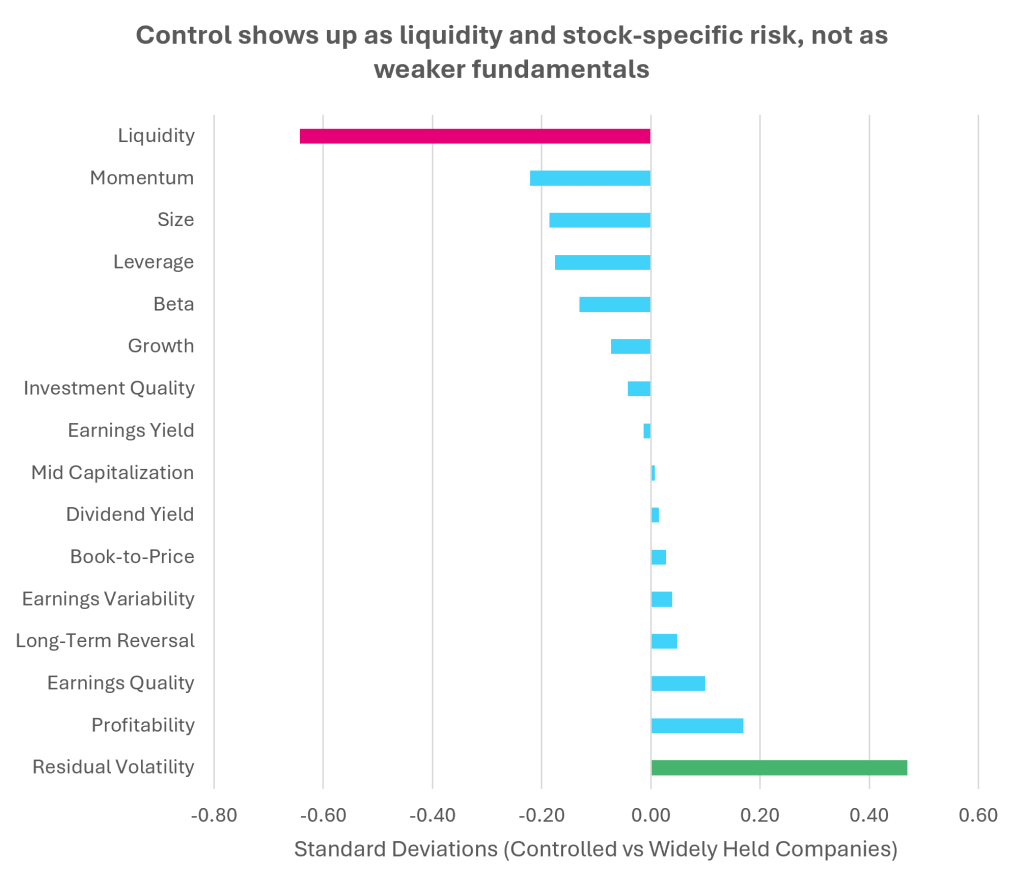
Source: MSCI GEMLT model. Controlled (30%+ of votes, n=657) vs widely held (under 10%, n=212), controlling for country and size. Colour key: green = statistically significant positive; pink = statistically significant negative; blue = not statistically significant. Data taken as of August 2026.
For investors, the risk has to be quantified directly rather than relying on standard vendor corporate governance scores. The ‘wedge’ between voting rights and economic ownership, the pattern visible in Alphabet, Fox and Under Armour’s pricing, is a vital method to assess this issue.
For systematic investors, the task is not to avoid governance risk altogether, but to understand where control sits, quantify the risk it creates and direct their engagement to where they can have a tangible effect on outcomes.
Important Information
This document was prepared and issued by Osmosis Investment Research Solutions Limited (“OIRS”). OIRS is an affiliate of Osmosis Investment Management US LLC (regulated in the US by the SEC) and Osmosis Investment Management UK Limited (regulated in the UK by the FCA). OIRS and these affiliated companies (together, “Osmosis”) are wholly owned by Osmosis (Holdings) Limited, a UK-based financial services group.
The information contained in this document has been obtained by Osmosis from sources it believes to be reliable but which have not been independently verified. Information contained in this document may comprise an internal analysis performed by Osmosis and be based on the subjective views of, and various assumptions made by, Osmosis at the date of this document. Osmosis does not warrant the relevance or correctness of the views expressed by it or its assumptions. Except in the case of fraudulent misrepresentation or as otherwise provided by applicable law, neither Osmosis nor any of its officers, employments or agents shall be liable to any person for any direct, indirect or consequential loss arising from the use of this document.
The information does not constitute an offer or solicitation for the purchase or sale of any security, commodity or other investment product or investment agreement, or any other contract, agreement, or structure whatsoever. The information is intended only for the use of eligible and qualified clients and is not intended for retail clients. Recipients are responsible for making your own independent appraisal of and investigations into the products referred and not rely on any information as constituting investment advice. Investments like these are not suitable for most investors as they are speculative and involve a high degree risk, including risk of loss of capital. There is no assurance that any implied or stated objectives will be met. Osmosis has based the information obtained from sources it believes to be reliable, but which have not been independently verified. Osmosis is under no obligation and gives no undertaking to keep the information up to date. No representation or warranty, express or implied, is or will be made, and no responsibility or liability is or will be accepted by Osmosis, or by any of its officers, employees, or agents, in relation to the accuracy or completeness of the information. No current or prospective client should assume that future performance will be profitable the performance of a specific client’s account may vary substantially due to variances in fees, differing client investment objectives and/or risk tolerance and market fluctuations.