




For the last few decades, carbon has dominated the conversation around sustainable investing. Reducing emissions is clearly critical in the transition to a more sustainable economy, but focusing solely on carbon risks overlooking another resource constraint that may prove equally important for long-term investors: water.
World Water Day is a United Nations initiative designed to encourage dialogue and spread awareness for water-related themes impacting our society and environment. It is in this spirit that we explore the significance of water for investors.
The environment is not just a carbon issue
Water sits at the foundation of the global economy. From agriculture and manufacturing to energy generation and technology infrastructure, nearly every industry depends on reliable access to water. Yet, compared with carbon emissions, water usage has received far less attention in investment frameworks. Today there are hundreds of climate and low-carbon benchmarks and strategies globally, while only a handful focus specifically on water.
At Osmosis, our Model of Resource Efficiency evaluates companies across three environmental metrics: carbon emissions, water consumption and waste generation. Itidentifies those that produce the greatest economic value while using the fewest natural resources. By favouring firms with lower water intensity relative to their sector peers, the approach systematically rewards companies that manage water more efficiently and are therefore better positioned to operate in a resource-constrained world.
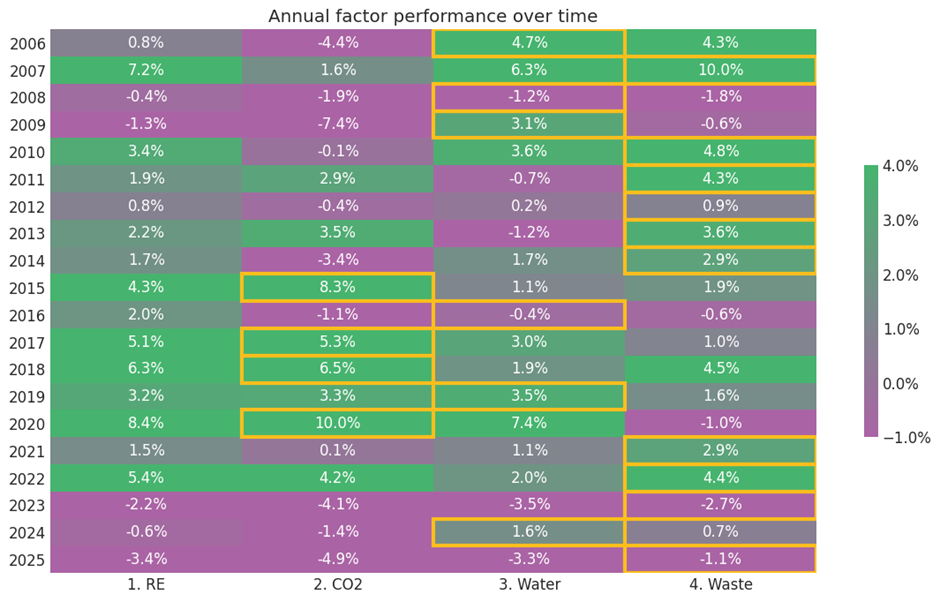
Our research shows that those who overlook water are missing out. In only 4 of the last 20 years carbon has been the top performing factor, and therefore driver of return. Water and waste have provided differentiated signals, which contributed positively in times when carbon underdelivers. For investors, this suggests that focusing solely on carbon may not only overlook risk, but also potential sources of return and diversification. Such evidence has informed our proprietary Model of Resource Efficiency for over a decade.
What are the risks of overlooking water?
Beyond return potential, water also represents a growing source of financial risk. Global demand for freshwater continues to grow alongside population and economic development, while climate change is increasing the volatility of water supply in many regions. In 2023, the WWF warned that by 2050 around 46% of global GDP could come from areas facing high water risk. Water scarcity is becoming an increasingly important economic constraint, particularly in regions where industrial activity, population growth and climate pressures are converging.
One way to understand water risk is to examine water intensity — the amount of water used relative to economic output. Companies that require large volumes of water to generate revenue may face rising operational costs, regulatory pressures, reputational backlash, or physical supply constraints in the future. According to the Carbon Disclosure Project, $77 billion is under threat due to water risk in supply chains (Stewardship at the Source, 2024).
Who is affected the most?
These risks are not evenly distributed across the economy or globe. Water intensity is particularly high in sectors such as agriculture, semiconductors, energy production and hospitality – industries where reliable access to water is fundamental to operations. In water-stressed regions, even small differences in water efficiency between companies can signal meaningful differences in operational resilience over time.
Nowhere are water risks more financially material than in mining, where operational disruptions, regulatory penalties and remediation costs can run into the billions (WWF, 2020). Effective management of water, alongside carbon and waste, is critical. Kinross Gold, a gold mining company in our universe, has two of its key mines located in water-stressed regions. Water stewardship is therefore of particular economic importance. Our research indicates that Kinross’ water intensity remains orders of magnitude higher than that of its peers.
One of these peers, Pan American Silver, a major producer of silver and gold, demonstrates a markedly different performance. Its water intensity is more than 20 times lower than Kinross’ – low enough to stay within the rate at which water sources are naturally replenished, and therefore not contributing to water stress. A key differentiator is its site-specific approach to water management. At its Jacobina mine in Brazil, the company has established a dedicated water management department, enabling more strategic, locally tailored decision-making from both operational and environmental perspectives.
Our research shows that more efficient miners, such as Pan American Silver, are more prepared to face the looming economic costs of resource scarcity: lower carbon emissions, lower water usage and lower waste production can result in increased resilience in the face of carbon taxes, higher water prices and new waste management standards. Furthermore, their supply chains are less exposed to climate volatility, such as drought, thus reducing potential operational risk.
It also highlights a broader point for investors. Strategies focused solely on reducing portfolio carbon intensity may still allocate to companies that are relatively inefficient users of other natural resources. Assessing environmental performance more holistically can therefore reveal differences that carbon-only approaches may overlook.
Addressing water risks
For investors, water is no longer a peripheral issue – it is an increasingly material driver of risk, resilience and return. As water scarcity intensifies and its economic impacts become more visible, incorporating water alongside carbon and waste provides a more complete view of corporate sustainability. Companies best positioned for the future will not simply be those that emit the least carbon, but those that generate the most economic value while using the fewest natural resources. In this context, a broader Resource Efficiency lens is not just an environmental preference, but a necessary evolution in how investors identify risk and target long-term alpha.
Important Information
This document was prepared and issued by Osmosis Investment Research Solutions Limited (“OIRS”). OIRS is an affiliate of Osmosis Investment Management US LLC (regulated in the US by the SEC) and Osmosis Investment Management UK Limited (regulated in the UK by the FCA). OIRS and these affiliated companies (together, “Osmosis”) are wholly owned by Osmosis (Holdings) Limited, a UK-based financial services group. Osmosis has been operating its Model of Resource Efficiency since 2011.
Information in this presentation is intended to be viewed in its entirety. The reproduction, downloading, streaming or other disclosure of such information, in whole or in part, without prior consent of Osmosis is prohibited. Neither this presentation, nor any copy of the information available on it, may be taken into or transmitted in any jurisdiction where it would be unlawful to do so.
The information contained in this document has been obtained by Osmosis from sources it believes to be reliable but which have not been independently verified. Information contained in this document may comprise an internal analysis performed by Osmosis and be based on the subjective views of, and various assumptions made by, Osmosis at the date of this document. Osmosis does not warrant the relevance or correctness of the views expressed by it or its assumptions. Except in the case of fraudulent misrepresentation or as otherwise provided by applicable law, neither Osmosis nor any of its officers, employments or agents shall be liable to any person for any direct, indirect or consequential loss arising from the use of this document.
Investments like these are not suitable for most investors as they are speculative and involve a high degree of risk, including risk of loss of capital. There is no assurance that any implied or stated objectives will be met. This material is provided for illustrative purposes only.
This document alone does not constitute: a recommendation by, or advice from, Osmosis or any other person to a recipient of this document on the merits or otherwise of participating in the products, investments and transactions referred to in this document; a guarantee, forecast, projection or estimate of any future returns (or cash flows) on any investment; or investment, tax or other advice. Potential investors should read the relevant fund’s prospectus or offering memorandum, and consult their own legal, tax, accounting and other professional advisers before making any investment.
Performance
NO REPRESENTATION IS BEING MADE THAT ANY ACCOUNT WILL OR IS LIKELY TO ACHIEVE PROFIT OR LOSSES SIMILAR TO THOSE SHOWN. Information is shown to support the Osmosis research process, no representation is being made that an Osmosis strategy will achieve the Efficient performance shown.
Past performance is not an indication of future performance. Different types of investments and/or investment strategies involve varying levels of risk, and there can be no assurance that any specific investment or investment strategy will be profitable. No current or prospective client should assume that future performance will be profitable, equal the performance results reflected, or equal any corresponding historical benchmark index. For reasons including variances in fees, differing client investment objectives and/or risk tolerance, market fluctuation, the date on which a client engaged Osmosis’s services, and any account contributions or withdrawals, the performance of a specific client’s account may have varied substantially from the referenced performance results. In the event that there has been a change in a client’s investment objectives or financial situation, the client is encouraged to advise us immediately. It is important to remember that the value of investments, and the income from them, can go down as well as up and is not guaranteed and that you, the investor, may not get back the amount originally invested. Any forecast, projection or target where provided is indicative only and is not guaranteed in any way. Osmosis accepts no liability for any failure to meet such forecast, projection or target.
Resource Efficiency Our research identifies companies from the MSCI World or Emerging Market Index that report sufficiently on at least 2 of the following 3 metrics: carbon, water, and waste, to calculate a resource efficiency score for each reporting company – the Model of Resource Efficiency. Our Core strategies overweight efficient companies and underweight inefficient companies within each Osmosis defined sector, to remain sector neutral to each benchmark. Our Active strategies invest only in efficient companies, outside of the Financial sector described below. Companies in the Financials sector are not given Resource Efficiency Scores. Certain strategies select Financials, based on complementary characteristics to the Resource Efficiency factor, for inclusion in the portfolio to maintain the portfolio’s overall factor weightings. All strategies exclude tobacco and companies that breach the UN Global Compact on social and governance safeguarding.
Investment Examples The investment examples set forth in this presentation should not be considered a recommendation to buy or sell any specific securities. There can be no assurance that such investments will remain in the strategy or have ever been held in the strategy. The case studies have been selected to be included in this presentation based upon an objective non-performance basis because we believe these are indicative of our strategy and investment process. Nothing herein shall be deemed to limit the investment strategies or investment opportunities to be pursued by Osmosis.
Information pertaining to Osmosis’s advisory operations, services, and fees are set forth in Osmosis’s current disclosure statement (Form ADV Part 2A), a copy of which is available from Osmosis upon request and from the SEC at http://www.adviserinfo.sec.gov. Information regarding OHL is available from us upon request.