

By Leeja van Bezouwen, Credit Analyst, and Victor Verberk, CIO
Something unusual is happening in credit markets. Companies with negative free cash flow, capex running at multiples of their operating cash and sometimes even revenues, and projected debt growth into the hundreds of billions are receiving investment grade ratings.
We’ve spent a lot of time on AI infrastructure financing as part of our research, looking at the unit economics of AI models, the financial position of the labs, and how the underlying deals actually work. Last time we looked into the accounting practices and circularity of company ownership[1]. Now we turn to our investment process.
Some AI infrastructure providers (hyperscalers) have made a strategic decision to position themselves at the centre of the AI buildout. These are taking on long-term obligations and investing heavily in specialised hardware to capture a share of what they believe could be a generational market. But when we look at the characteristics of the activity being funded, what we see looks very different from what the credit rating implies. That is important knowledge as our investment process includes a corporate analysis comprising five pillars: Business Position, Corporate Strategy, Sustainable Investing, Financial Position and Structure. This process has helped this credit team avoid a single default across our investment grade portfolios for over 18 years. Let’s have a look.
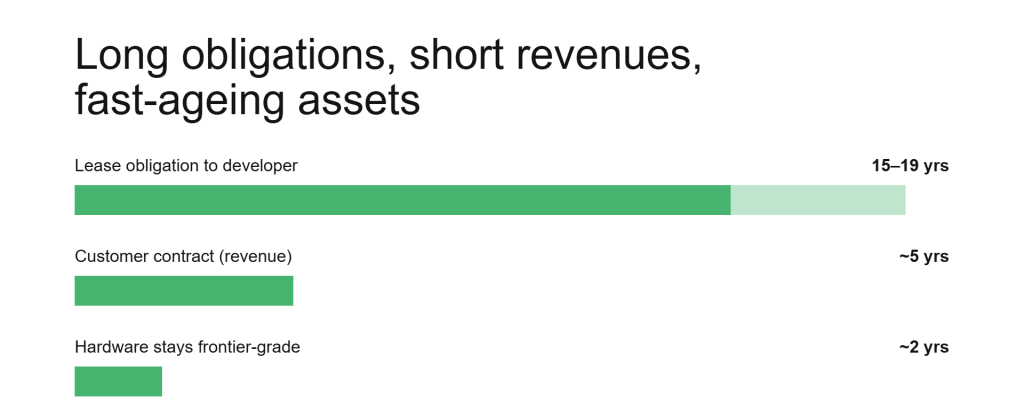
These providers typically lease facilities on terms of 15 to 19 years, install the hardware, and rent out computing capacity to tenants (AI labs) on contracts of roughly five years with renegotiation provisions. The lease obligations are long and fixed. The customer revenue is shorter and conditional. The hardware, however, is no longer frontier-grade within two years as new chip generations arrive. The depreciation is very punitive. Pricing for compute is not static either: industry data suggests rental rates for previous-generation chips soften as newer hardware comes to market. This combination, long fixed costs set against shorter revenues and fast-eroding assets, is what weighs on the Business Position, since reinvestment and the matching of cash flows become critical.
The major AI Labs remain heavily loss-making, with some reporting negative operating margins exceeding 100%[2]. Their ability to meet multi-year infrastructure commitments depends on continued access to equity capital markets to plug the gap. Some financing arrangements also have a circularity to them, with chip suppliers investing in the same companies whose infrastructure commitments ultimately fund chip purchases, making the Structure opaque. The investment race is now so fierce that debt is being issued as well, which changes the Financial Position materially.
The datacentre facilities are also less fungible than they appear. Much of what’s being built is purpose-built for frontier AI training: gigawatt-scale clusters with specialised cooling and networking designed for workloads that only a handful of organisations run globally. The broader economy’s AI demand is predominantly for inference, a different workload that runs on standard cloud infrastructure. Re-tenanting assumptions depend on a pool of replacement demand that is, for now, very narrow. A risky strategy since nobody can tell us whether re-tenanting is possible.
We invest according to five Investment Principles[3]: Managing behavioural biases, Mean Reversion of markets, understanding the global macro, Sustainable Investing and Winning by not Losing while nurturing a safety margin (for error). This last one is important for Investment Grade clients.
Investment grade has always meant a margin of safety, room for things to go differently than planned without the creditor getting impaired. What the current datacentre structures require to be and remain profitable is the opposite: everything needs to go right, simultaneously, over a long time horizon. Demand has to arrive at scale to provide real external client money flows. Hardware has to stay current and depreciation speed is unclear. Tenants have to stay funded and the structure of funding requires transparency. Pricing has to hold to prevent holes in the capital expenditures programs. In our view, this doesn’t imply a prudent margin of safety, nor an investment grade rating.
[1] https://www.osmosisim.com/a-credit-perspective-on-ai-infrastructure-accounting/
[2] Financial Times – “OpenAI spending hit $34bn last year ahead of planned IPO”
[3] Bias, Victor Verberk 2023
Important Information
Osmosis Investment Management NL B.V. (Osmosis NL) is licensed as an Alternative Investment Fund Manager (AIFM) under the Alternative Investment Fund Managers Directive (AIFMD) and the Dutch Financial Supervision Act (Wet op het financieel toezicht, Wft) and authorized to provide discretionary portfolio management services. Osmosis NL is subject to supervision by the Dutch Authority for the Financial Markets (AFM).
This document and any marketing communication are intended solely for Professional Investors as defined in the Wft. It is not directed at, nor intended for distribution to, any person in any jurisdiction where such distribution would be unlawful.
The information provided is for general information purposes only and does not constitute investment advice, a recommendation, research or an offer or solicitation to buy or sell any financial instrument. It is not tailored to individual circumstances or investment objectives.
The views expressed are as of the date of publication of this document and may change without notice. Although this information is obtained from sources believed to be reliable, no representation or warranty is made as to its accuracy or completeness. Osmosis NL accepts no liability for any direct or indirect loss arising from use of this information.
Past performance is not a reliable indicator of future results. No representation or warranty is made that any account or investment will achieve results similar to those shown. Actual results may differ substantially due to factors such as market conditions, timing and pricing of trades, portfolio composition, fees, and client circumstances. Investments can fall as well as rise in value and may result in the loss of capital. Forecasts, projections, or targets are for illustrative purposes only and are not guaranteed in any way.
Any investment examples included herein are for illustrative purposes only and do not constitute a recommendation to buy or sell any specific security. There is no assurance that such investments will remain in the strategy or have ever been held. Case studies have been selected on a non-performance basis as indicative of the investment approach and process.
Benchmark information is provided for comparison purposes only. Indices are unmanaged, not available for direct investment, and do not reflect the deduction of fees or expenses, which would reduce returns. Past benchmark performance is not a reliable indicator of future results, and the referenced benchmarks may not be appropriate for all investors.
If reference is made to an investment fund, please refer to the relevant fund’s prospectus or offering documents with more details on investment objectives, costs, and risks before making any final investment decisions.
Scenarios and performance presented are estimates based on past data and current market conditions and are not exact indicators of future results. Actual outcomes will vary depending on market performance and the duration of investment.
Clients are encouraged to consult their own legal, tax, accounting, and other professional advisers before making investment decisions and to promptly inform Osmosis NL of any changes to their investment objectives or financial situation.
For Australian Investors: Osmosis NL is a Corporate Authorised Representative (CAR 001316961) of Eminence Global Asset Management Pty Ltd (EGAM) (AFSL holder 305573). Where Osmosis NL provides financial services in Australia, it does so as an authorised representative on behalf of EGAM. The information and materials contained in this document have been prepared for accredited wholesale clients only, as defined by the Corporations Act 2001 (Cth) and in accepting the content of this document, you warrant that you are such an investor.