

Marketing material – for professional investors only
- Management fees continue to trend lower, even as IT cost inflation and organisational complexity push fixed costs up.
- AI is redefining job descriptions faster than governance and job-security concerns can adapt.1
- Consultants will tell you scale is the answer, but it actually is not – size brings a complexity tax rather than the efficiency they promise.
- Sustainable investing adds its own data and reporting cost layer – ‘SI is IT’.
- Rising regulation – including DORA and the AI Act – pushes management teams toward ‘no change’. Firms stay on costly legacy systems and manual controls, so the cost of the ‘licence to operate’ keeps rising.
In this article, we describe how a boutique like Osmosis NL (Netherlands), affiliate of the Osmosis Group, can benefit from AI by embedding technology across its processes. The answer is not necessarily a new function, such as a CTO or Head of AI and Technology. The answer is to embed technology into the existing organisation. For example, our Head of Research has become Head of Research and Technology.
Generally speaking, smaller and younger companies have fewer legacy systems and fewer vested interests. Therefore, a small company can punch above its weight via the right use of technology rather quickly – technological creative destruction in full force.
AI Paradox
We have described the AI paradox in which management teams want to use AI, as do employees. At the same time, resistance to change, compliance and a desire for job security prevent fast integration and adoption of AI, especially in large, well-established companies. In some companies, there is a ban on using LLM models altogether.
In this chapter, we explain another AI paradox: one would expect much higher technology costs and hence higher IT spend as a result. But this is not the case. We have reduced the cost structure in our business case and budget planning, including future headcount, several times now – productivity has increased while cost structures have decreased, also versus planning.
Osmosis NL started adopting AI technology in its credit team. Drawing on the team’s experience across thousands of credit committees, we have designed an AI Agent that reads vast numbers of pages of trusted documents, such as annual reports. The AI Agent operates within defined research protocols rather than with open-ended autonomy. Based on specifically designed questions for each company and sector, AI software produces research in hours instead of days. The AI Agent also reads across languages. There are limitations too: controlling for hallucination, making sure the AI Agent does not have an opinion, and recognising that computing power also has a cost element to it. A small team is as big as it wants to be this way – company size matters much less than it used to.
‘Make sure the investment process and team do not change. Clients have subscribed to that, not to a machine.’
Cost Structure of an Asset Manager
Our peer group is Western European, institutional/wholesale, with a dominant fixed income book of business – our own background. So, we know these cost structures from experience, both at aggregate asset management level and per investment capability. Based on our own experience, we have come to the following indicative cost levels for a steady-state Asset Manager 1.0.
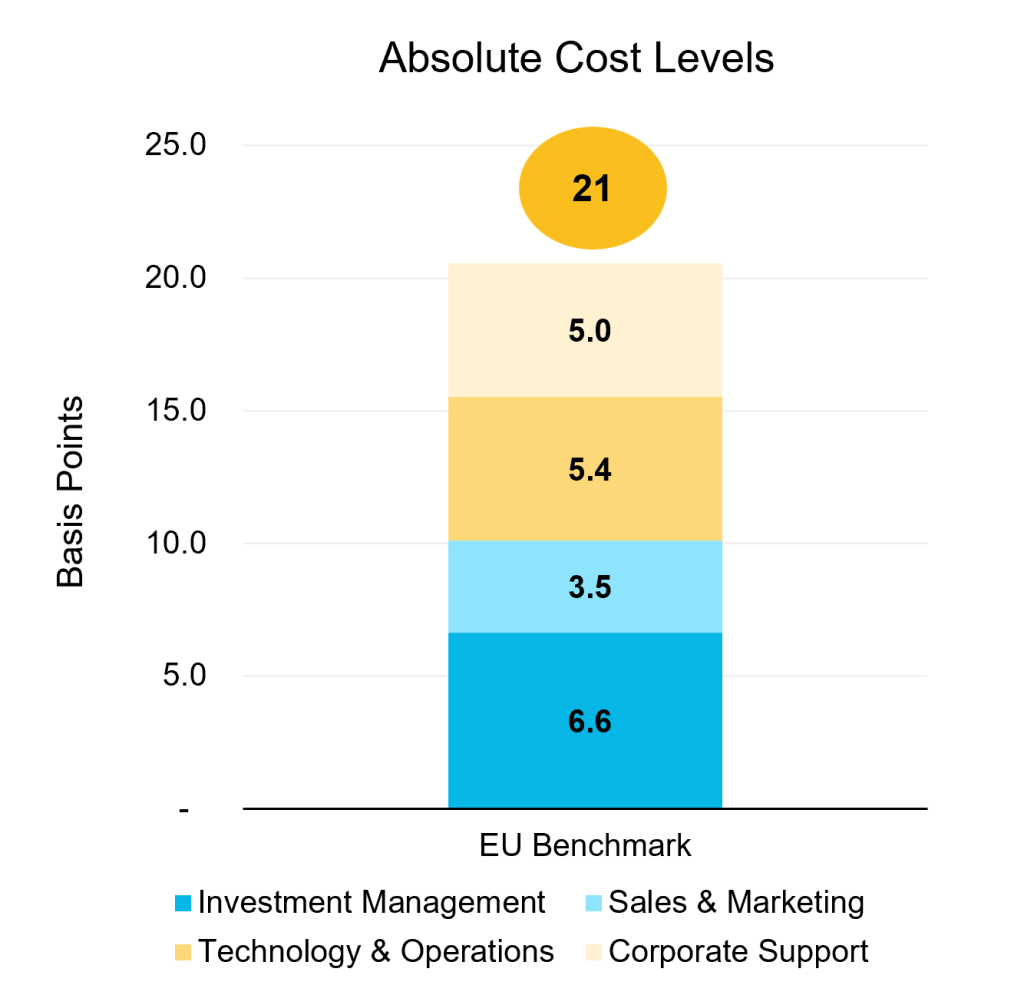
In practice, we do not know where we end up in five or ten years – technological developments and compute costs are moving too fast to call. We can only make a working estimate based on our current views and understanding.
‘We do not know where it ends – and that is the exciting part.’
The following business cases are concrete examples of how Osmosis NL is actively limiting its cost levels today.
Business Case 1 – creation of in-house data
Data is an ever-increasing cost of doing business. Examples include investment data for back-testing, operational data for pricing, and static data used for NAV calculations. On top of that sits sustainable investment data – such as issuers’ Scope 1, 2 and 3 emissions and EU Taxonomy data – as well as reported accounting data feeding valuation models. All of it carries substantial fees. Everyone knows the data vendors and the market power they have.
Osmosis NL has found that, increasingly, we do not need to buy these data points. Using the same AI Agent technology, we read and scrape data from annual reports, sustainability reports and public web sources. Where the data is publicly available, including data required by the EU to be reported, we gather it ourselves via AI Agents we have developed. To date, we have materially reduced data purchasing and hence lowered the cost base.
Asset owners often purchase the same data we do. We can share our proprietary data with clients alongside performance reports, helping to ensure transparency on portfolio investment decisions and composition and enabling clients to ‘know what they own’. This creates a lower cost base on both sides: the cost of our data is lower, which enables us to lower management fees, while clients can decrease their spend on external data.
The fact is, we believe the relationship with the client will deepen through a mutually beneficial data-sharing model.
Business Case 2 – credit research redefined
Historically, at our team’s prior firm, credit research was written by dozens of analysts, each covering some forty corporate issuers. It took over ten days to write a good credit report. The AI Agent now enables the analyst to produce the report much faster, and the quality is better – after all, much of the data and information around a company is in text format, and the AI Agent can digest far more information, across many different languages. In the old days, typically one analyst was hired for every EUR 1 billion of AUM or EUR 2 million of revenues. That relationship has broken down – we need far fewer research professionals for the same assets under management. With AI doing the majority of the data heavy-lifting, there is much more time for an analyst to spend on making judgement calls and seeking to add alpha.
‘The relationship between AUM and investment professionals has broken down.’
Business Case 3 – increased employee productivity
We actively encourage all employees to use AI, for example Claude Enterprise. With appropriate confidentiality controls, productivity gains show up across the board – drafting a good PowerPoint presentation takes hours instead of weekends. We carefully manage what we input to LLMs, to limit the risk of sensitive information being used for training.
This productivity gain is spread across all functional users, not concentrated in a larger technology team. IT professionals themselves do not have to write code anymore – AI models draft the code, while the IT professional evaluates, tests and finalises it. Hence the share of the wallet that IT costs comprise has decreased instead of increased.
It can be likened to ESG integration in the past. One should not have a large central ESG team that drives responsible investing top down. One should have ESG knowledge integrated into the culture of the investment process and even the organisation. The same is true of technology.
Business Case 4 – internal processes and control
Several key processes are now automated – logging investment decisions and reviewing them for bias. Our internal control is materially stronger than before: every data point and every piece of research is stored, including every financial data point, so even individual contributions to investment decisions can be analysed. There is no room for egos here – only room for self-learning professionals open to AI-based coaching. Auditability is significantly improved without large investments.
‘Tracing and auditing investment decisions have materially improved.’
Client Relationships
We think client relationships will change at two main levels. First, the data-sharing model described above means data will democratise fast – the price of a data point devalues rapidly, and the marginal cost of adding a data field to our AI Agent output is close to zero. Second, higher productivity and a lower cost structure drive better, faster, cheaper and almost unlimited research services – and the asset manager can pass this advantage on to the client. Management fees will go lower again. In credit management, passive solutions are notoriously expensive to run, due to turnover, tracking error management, trading, and the constant redemption and issuance process – so active management fees may approach passive fees.
We have a state-of-the-art, scalable and highly efficient operating platform with no legacy infrastructure. As such, we can estimate our cost levels for the next phases of growth, and after growing to a business-as-usual level, we expect to be cost effective. A few observations already stand out:
- In our second year of being operational, we have reduced the future personnel budget by 25% versus the original plan for the next three-year budget.
- All cost buckets participate in the productivity gains – including IT. Despite increased spending on computing tokens, one integrated stack for research and one for portfolio management keep complexity, and therefore cost, in check. A cloud-based research and front-office set-up also means far fewer interfaces to maintain, and fewer cybersecurity updates or implementation cycles.
- Data purchasing has also been reduced multiple times, as AI Agents now do this work directly – removing another layer of cost.
All in all, we estimate we can service clients at 20% lower management fees to start with, versus traditional peers. We are at an early stage of our growth trajectory in AUM, so this is just the beginning. Below, we estimate our cost structure at a hypothetical EUR 10 billion AUM – an internal estimate based on our own research and assumptions, which may prove materially different.
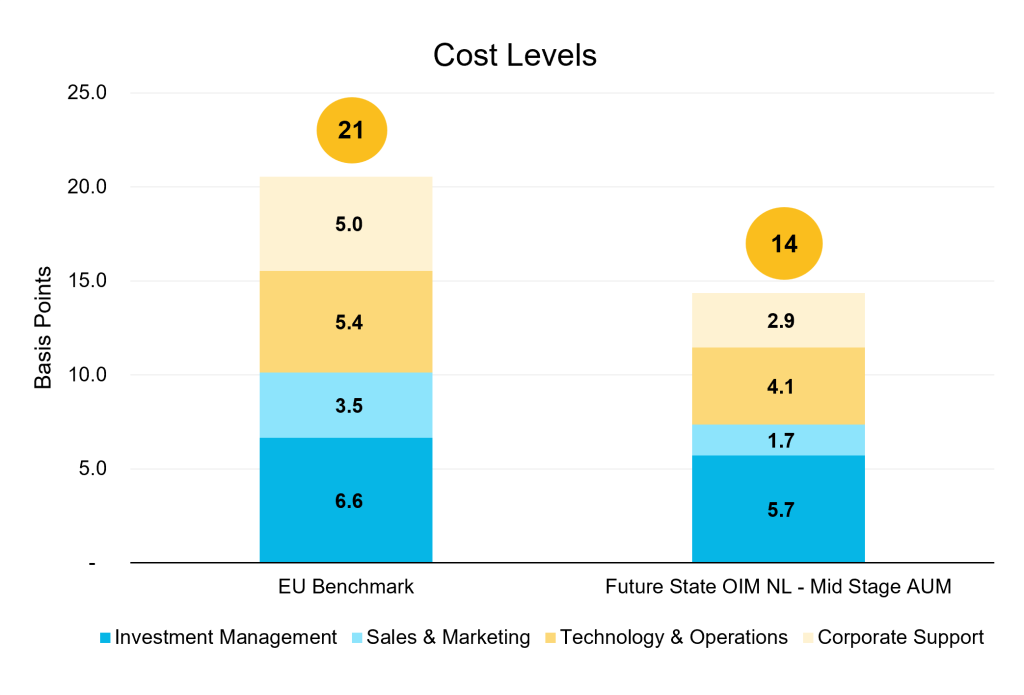
Source: Osmosis NL – Analysis based on publicly available industry data (including McKinsey, Global/European Asset Management reviews 2023–2025; BCG, Global Asset Management 2024–2025). Projected cost levels are based on current assumptions and are subject to change.
Conclusion
We experience a multiplier effect: technology drives productivity up, and the quality of output improves – but only when it is applied to proven investment processes, tested over thousands of cases. The process has not changed for the client, and neither have the people. We invest in the next generation of investment professionals – tech-savvy people with a love for accounting, too. It is the way of working that has changed.
‘Technology is going to deliver a multiplier effect. We do not yet know the end-stage benefit.’
Hence, the rare result: cost can go down in absolute terms even as output goes up – a real paradox. The “AI oil stain” spreads across more and more roles in the organisation, while technology costs fall. IT personnel can see a fivefold increase in coding productivity. If implemented well, this combination of higher productivity, lower overhead costs and lower technology costs drives down the cost-income ratio for an Asset Manager 2.0. This could reduce cost per AUM by as much as 30%. Over time, we expect to pass a significant share of these efficiency gains on to clients. Greater data sharing could enable us to deliver even more value.
Important Information
Osmosis Investment Management NL B.V. (Osmosis NL) is licensed as an Alternative Investment Fund Manager (AIFM) under the Alternative Investment Fund Managers Directive (AIFMD) and the Dutch Financial Supervision Act (Wet op het financieel toezicht, Wft) and authorized to provide discretionary portfolio management services. Osmosis NL is subject to supervision by the Dutch Authority for the Financial Markets (AFM).
Osmosis NL is an affiliate of Osmosis Investment Management UK Limited (“Osmosis UK”) and a member of the Osmosis Group of Companies. Osmosis UK, Osmosis Investment Management US LLC (“Osmosis US”) and Osmosis Investment Management (Australia) Pty Ltd (“Osmosis AUS”) are wholly owned by Osmosis (Holdings) Limited (“OHL”) and with Osmosis NL, are collectively referred to throughout as “Osmosis Group”.
This document and any marketing communication are intended solely for Professional Investors as defined in the Wft. It is not directed at, nor intended for distribution to, any person in any jurisdiction where such distribution would be unlawful.
The information provided is for general information purposes only and does not constitute investment advice, a recommendation, research or an offer or solicitation to buy or sell any financial instrument. It is not tailored to individual circumstances or investment objectives.
The views expressed are as of the date of publication of this document and may change without notice. Although this information is obtained from sources believed to be reliable, no representation or warranty is made as to its accuracy or completeness. Osmosis NL accepts no liability for any direct or indirect loss arising from use of this information.
Past performance is not a reliable indicator of future results. No representation or warranty is made that any account or investment will achieve results similar to those shown. Actual results may differ substantially due to factors such as market conditions, timing and pricing of trades, portfolio composition, fees, and client circumstances. Investments can fall as well as rise in value and may result in the loss of capital. Forecasts, projections, or targets are for illustrative purposes only and are not guaranteed in any way.
Any investment examples included herein are for illustrative purposes only and do not constitute a recommendation to buy or sell any specific security. There is no assurance that such investments will remain in the strategy or have ever been held. Case studies have been selected on a non-performance basis as indicative of the investment approach and process.
Benchmark information is provided for comparison purposes only. Indices are unmanaged, not available for direct investment, and do not reflect the deduction of fees or expenses, which would reduce returns. Past benchmark performance is not a reliable indicator of future results, and the referenced benchmarks may not be appropriate for all investors.
If reference is made to an investment fund, please refer to the relevant fund’s prospectus or offering documents with more details on investment objectives, costs, and risks before making any final investment decisions.
Scenarios and performance presented are estimates based on past data and current market conditions and are not exact indicators of future results. Actual outcomes will vary depending on market performance and the duration of investment.
Clients are encouraged to consult their own legal, tax, accounting, and other professional advisers before making investment decisions and to promptly inform Osmosis NL of any changes to their investment objectives or financial situation.
For Australian Investors: Osmosis NL is a Corporate Authorised Representative (CAR 001316961) of Eminence Global Asset Management Pty Ltd (EGAM) (AFSL holder 305573). Where Osmosis NL provides financial services in Australia, it does so as an authorised representative on behalf of EGAM. The information and materials contained in this document have been prepared for accredited wholesale clients only, as defined by the Corporations Act 2001 (Cth) and in accepting the content of this document, you warrant that you are such an investor.
- The AI Productivity Paradox, Jankees Ruizeveld and Victor Verberk, Osmosis 2025 ↩︎